Vinyl-Faced vs. Foil-Faced Insulation: When Each One Wins
What the two most common insulation facings actually do, where each one earns its keep, and how to pick without overpaying for a feature you do not need.
By John P. Barber, Founder · Published July 23, 2026 · 8 min read
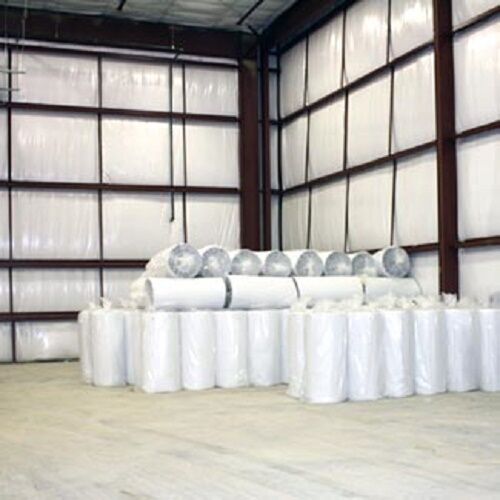
A buyer calls and asks: “Should I get the white vinyl-faced or the foil-faced?” The honest answer depends entirely on where the building is, what the roof looks like, and what problem the buyer is actually trying to solve. Here is how to make the call without being talked into the wrong one.
Start With What’s Identical
The fiberglass inside a vinyl-faced roll and the fiberglass inside a foil-faced roll are the same material. Same NAIMA-certified U.S. mill. Same spun glass. Same R-value per inch. Same thickness for a given R-value. When you compare an R-19 vinyl-faced roll to an R-19 foil-faced roll, the fiberglass itself does the identical thermal work.
What’s different is the thin sheet laminated to one side. That sheet — the facing — is where the two products start doing different jobs.
What Vinyl Facing Actually Does
Vinyl facing is a thin sheet of white polypropylene or polyester film. It has four jobs:
- Vapor retarder. Slows the movement of moisture from the warm interior toward the cold exterior side of the insulation. Different vinyl facings have different perm ratings — VR-R Plus at 5 perms, WMP-30 at 30 perms, WMP-50 at 50 perms. Higher perm = more breathability.
- Finished interior surface. The white face becomes your visible ceiling. No drywall required in most ag and light-commercial buildings — the facing is the finished look.
- Tensile strength. Holds the fiberglass together during install, keeps it from pulling apart when tension is applied over the roll, and gives it a clean edge for taping.
- Fire rating. Vinyl facing carries a Class A fire rating in most product lines, meeting the code requirement for exposed insulation on the underside of a metal roof.
Vinyl faces cost less to manufacture than foil faces. They’re also more forgiving during install — less prone to tearing, easier to seam-tape, and much easier for a small crew to handle overhead.
What Foil Facing Actually Does
Foil facing is a thin aluminum-coated film. It has three jobs:
- Radiant heat reflector. A polished foil surface bounces about 95 percent of the radiant heat that hits it. That is the reason foil facing exists in the first place — to reduce the radiant heat load coming off a hot metal roof in a southern climate.
- Complete moisture barrier. Foil is essentially impermeable to water vapor. Nothing gets through. That is a feature in some assemblies (cold storage, freezers, foundations) and a bug in others (any wall that needs to breathe).
- Higher tensile strength. Foil is slightly tougher than vinyl per unit thickness, which helps in high-vibration or high-abuse environments.
The radiant reflector job is real — but only when there’s an air gap on the shiny side. If the foil touches the roof panel directly (which happens whenever the insulation gets compressed against the purlin), the radiant reflector benefit largely collapses because heat now transfers straight through by touch.
Where Foil-Faced Wins
Foil is the honest choice in three situations:
- Hot-climate metal roofs. Texas, Arizona, Florida, Gulf Coast. A steel roof panel in July can hit 165°F. That is enormous radiant heat load pushing down into the building. Foil-faced insulation with the shiny side facing up toward the roof panel cuts that radiant load by 40 to 50 percent.
- Cold storage and freezer applications. When you need an absolute moisture barrier — not a retarder, a barrier — foil is the material that delivers it. Vinyl at any perm rating still lets some moisture through; foil does not.
- Below-grade insulation applications. Foil-faced rolls installed on the interior of a basement or foundation wall block both the temperature transfer and the ground moisture from reaching the fiberglass.
Where Vinyl-Faced Wins
Vinyl is the honest choice almost everywhere else:
- Any building that needs a finished interior. Pole barns, workshops, garages, ag buildings, small commercial. Vinyl facing IS the ceiling — no drywall needed. Foil facing looks industrial and reflects glare from any interior light, which most buyers find unpleasant to work under.
- Cold-climate roofs. Winter heat loss is dominated by conductive loss through the wall, not radiant loss. Foil does very little against conductive loss. Vinyl at the correct perm rating manages moisture in the assembly and lets the fiberglass do the thermal work.
- Any wall that needs to breathe. Most residential and light-commercial walls need some vapor to move through the assembly to prevent trapped moisture. Vinyl at 30 or 50 perms allows that. Foil traps it.
- Sound-attenuation applications. Vinyl facing lets fiberglass do its sound-absorbing job (fiberglass has the best acoustic performance of any common insulation). Foil-backed rolls reflect some sound in ways that reduce the fiberglass’s natural absorption.
- Every job where the cost premium of foil isn’t justified by a real radiant heat problem. Foil-faced rolls cost 10 to 20 percent more than comparable vinyl-faced rolls. That premium buys you a radiant reflector. If your climate isn’t creating a radiant problem, you’re paying for a feature that doesn’t apply to your building.
The In-Between Product: WMP-50
Our WMP-50 facing is a compromise product designed for buyers who want both benefits without picking one. It has a white polypropylene surface on the interior side (so it looks like vinyl and works as a finished ceiling) with a metalized polyester layer underneath that bounces about 75 to 85 percent of radiant heat.
WMP-50 costs about 15 percent more than VR-R Plus and about 5 percent more than WMP-30, but for a hot-climate warehouse or commercial building where the buyer wants radiant reflection AND a clean interior, it’s the honest pick over trying to spec pure foil-faced.
The Rule of Thumb
If your metal roof gets baked by the sun for most of the year — foil-faced (or WMP-50) at the roof, vinyl-faced at the walls. If your roof doesn’t get baked — vinyl-faced everywhere. Almost every metal-building or pole-barn job in the U.S. falls into one of those two answers, and the second one is far more common than sellers who profit from the foil markup will tell you.
When you’re not sure, call us before ordering. Tell us the state, the roof color, and whether the building will be conditioned. We’ll spec the facing that fits the job, not the one with the biggest price tag.
Deeper Reference
Related technical guides
Ready to price your facing?
The calculator on the homepage handles all four IO facings. Pick the one that fits your climate and see the delivered cost in about a minute.